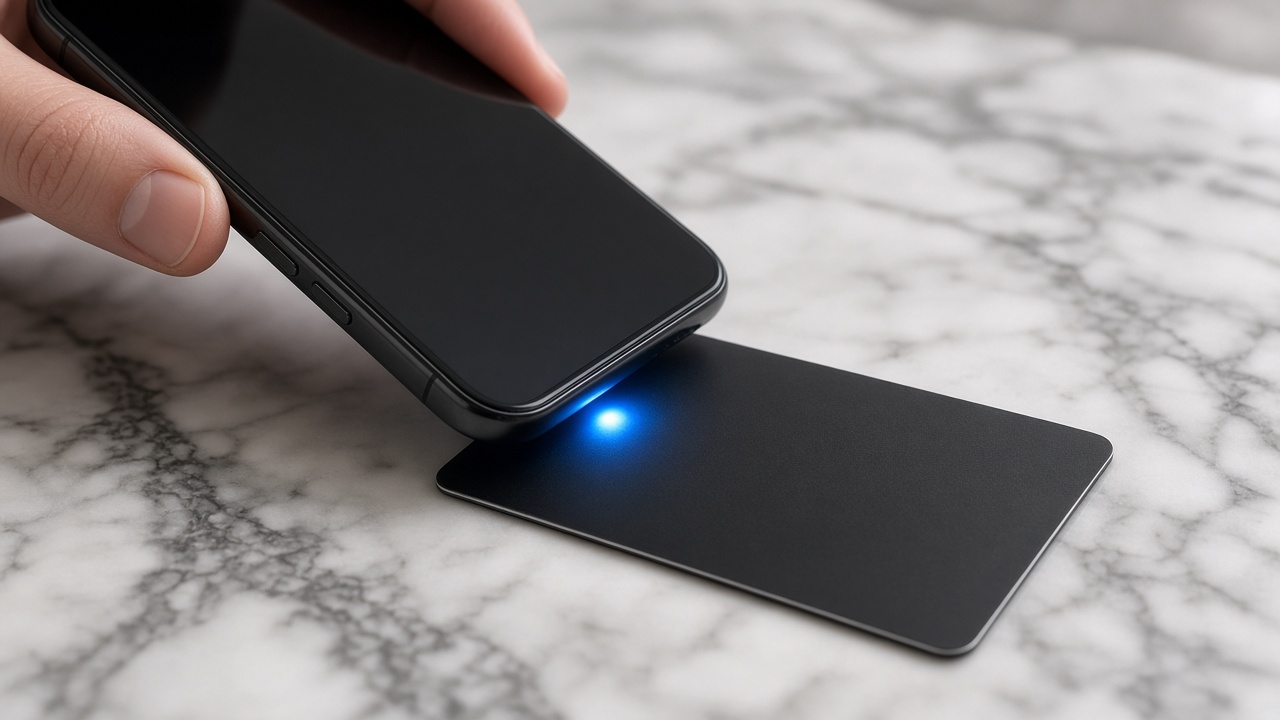
NFC — Near Field Communication — is a short-range radio exchange of data. Two devices come close, recognize each other and pass a small payload: a link, an identifier, a credential. There is no need to open the camera or frame a pattern. The gesture is a tap. That is why it is in phones, watches, payment terminals and, increasingly, on business cards.
How a tap works, without theater
A passive NFC chip does not need a battery. It is powered by the phone’s field when the phone comes close. The chip answers with a short record — often a URL or an identifier. The operating system interprets that record and opens the destination. Useful range is a few centimeters. That limit is not a flaw: it is the control. Anyone who is not at tap distance does not read the chip.
Unlike QR, NFC does not use the camera. It works in a dark room, at a booth with backlight or at a reception where nobody wants to hunt for the right angle. It also does not ask the other person to unlock a scanner: the reader is already in the hardware. The typical failure is not “NFC does not work”; it is a phone with NFC off, a metal case or a chip poorly placed relative to the antenna.
Why millions of readers are already in the field
Contactless payment trained the gesture. A generation of users already holds a phone or a card to a terminal without thinking. Manufacturers put NFC in devices for payments, transit and pairing. Once the radio is in the device, using it for a business card or a badge does not require new infrastructure in the customer’s pocket. The reader already travels with them.
That does not mean NFC has replaced every other channel. In 2026 NFC cards account for about 6.9% of digital-card shares, with 124% year-over-year growth. The base is smaller than QR; the slope is not. The NFC business-card market is estimated at a CAGR of about 14.8% through 2034. Adoption growth, not a miracle.
Proximity identity, not just marketing
In 2026 the same radio serves something more serious than a commercial link. The European Digital Identity Wallet (EUDI Wallet) uses NFC and Bluetooth Low Energy, and also QR, to present identity in proximity under ISO 18013-5. The pattern is the same: one device proves an attribute to another that is nearby, without sending the full document to an improvised server.
For a business, the lesson is not “you must issue identity documents.” It is that the phone is already a general-purpose proximity reader. Payment, access, a credential and a commercial card share the same gesture. Anyone designing a tap for a contact card is using an interface the user already understands in other contexts.
What NFC solves — and what it does not
- It solves zero distance. It fits when two people stand face to face and there is an object that can be brought to the phone.
- It solves low light and occupied hands. There is nothing to focus. The chip does not compete with a projector or a dark reception.
- It does not solve distance. A wall poster, packaging on a shelf or a slide cannot be “tapped.” There the QR remains the channel.
- It does not solve a weak destination. A tap that opens a slow page or an incomplete profile fails just as a scan does.
NFC is in millions of devices because payment and identity hardware already required it. The commercial use — handing over a contact with a tap — rides on that base. Treat it as a trade-show gadget and you lose the advantage: the advantage is the gesture, not the material of the card. The chip is only worth it if the destination, the data and the follow-up are ready when the phone comes close.