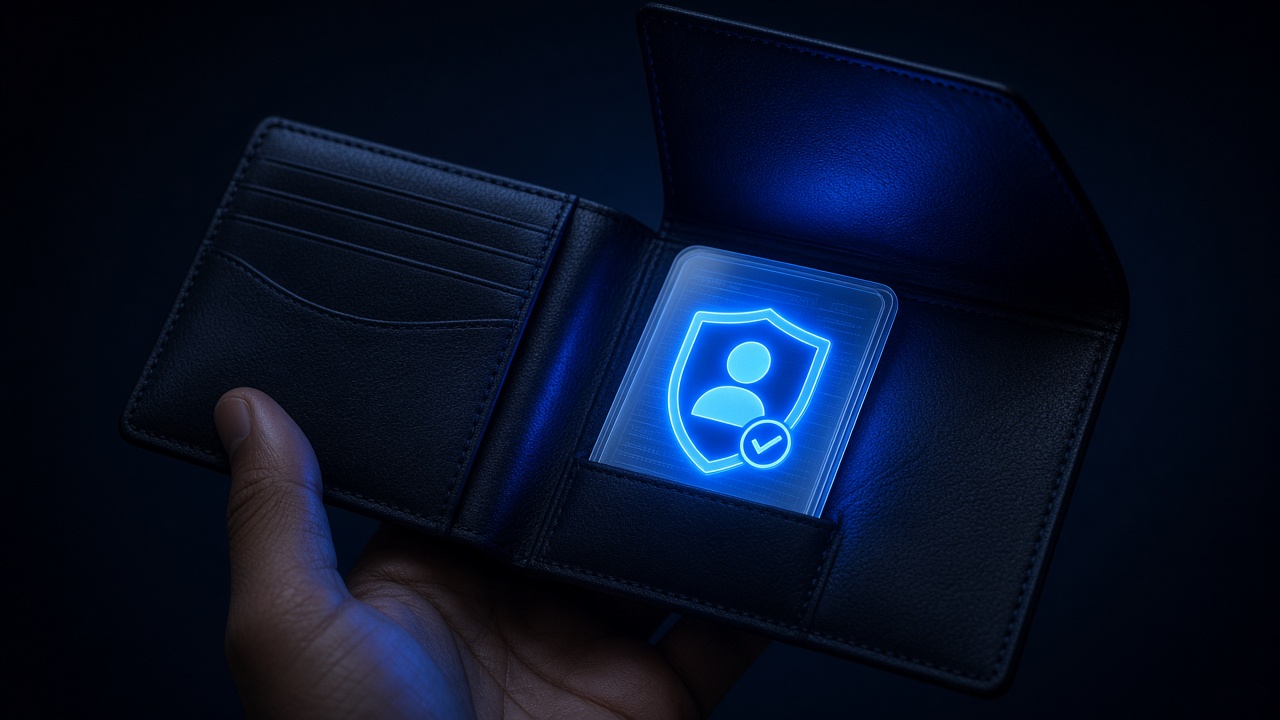
From a stored record to a presented credential
For twenty years a digital contact was a vCard: name, phone, email, sometimes a title. The other person saved it and you hoped it would not rot. That model is ending. Gartner projects 500 million digital identity wallets in 2026. The European Union requires member states to offer the EUDI Wallet before the year ends. The contact of the future is not a card you fill in. It is a claim the other person can verify without asking for the whole file.
The difference is trust. A vCard says what you typed. A verifiable identity says what an issuer stands behind and what the holder chooses to show. In B2B that changes the first minute: not «believe that I work here»; «check this attribute and let us continue».
Proximity: NFC, BLE and QR on the same layer
Verifiable identity does not live only in a government procedure. It lives at meeting distance. The 2026 pattern is proximity over NFC, Bluetooth Low Energy and QR. The digital-card mix — Wallet, QR, lock-screen QR and NFC — already rehearses that layer in professional exchange. The next step is that the same gesture presents a signed attribute, not only a link.
- NFC and BLE: the phone proves presence without spelling an email out loud.
- QR: the exchange works when there is no tap or when there is a counter.
- Wallet: the pass sits next to credentials the operating system already treats as stable.
Anyone designing the 2027 contact as a PDF with a code is designing the past. The recipient expects a gesture the phone already understands.
Selective disclosure: prove without oversharing
The piece that changes the craft is selective disclosure. You can prove you are over 18 without handing over your date of birth. You will, in a near horizon, be able to prove a role or an affiliation without handing over the whole document. For a company that is not a cryptographic detail. It is a data policy that finally matches what the client already demands.
Kantar and Meta found that 79.3% need proof of legitimacy. Today that proof is a domain, a published number, a coherent profile. Tomorrow it will be a verifiable attribute. Companies that still ask for «a photo of the document» for a minor step will be collecting risk they no longer need.
The right design is to ask for the minimum that closes the decision. If the fact does not change the next step, it is not requested. Verifiable identity makes that design technically possible. Commercial discipline has to make it habitual.
Agents, wallets and the contact that is not human
In August 2026 Cloudflare articulated identity and a wallet for AI agents that pay with a cap. The digital contact is no longer only a person. It can be an agent acting for a company, with an auditable identity and a spending limit. That forces a question in every exchange: who am I talking to, who stands behind them and what is their cap?
For a small firm the practical scenario is not to deploy a network of agents. It is to refuse an automatic counterpart that cannot present company, scope and limit. The same legitimacy test that applies to a salesperson on WhatsApp will apply to a system that writes in your name.
What you can adopt without waiting for 2028
The EUDI Wallet and the 500 million wallets will not land in a quarter. The habit can. A live profile, updatable without a reprint, shared through Wallet, QR, lock screen and NFC, is the layer a company can run today. When the verifiable credential becomes ordinary, that profile will be the destination the credential opens — not a PDF that has to be forwarded again.
BlimxCard sits on that practical layer: a digital contact you update once and present in the mix the other person already uses. It does not replace a sovereign identity wallet. It stops your company, while that wallet arrives, from handing over a detail that ages the day a title changes.