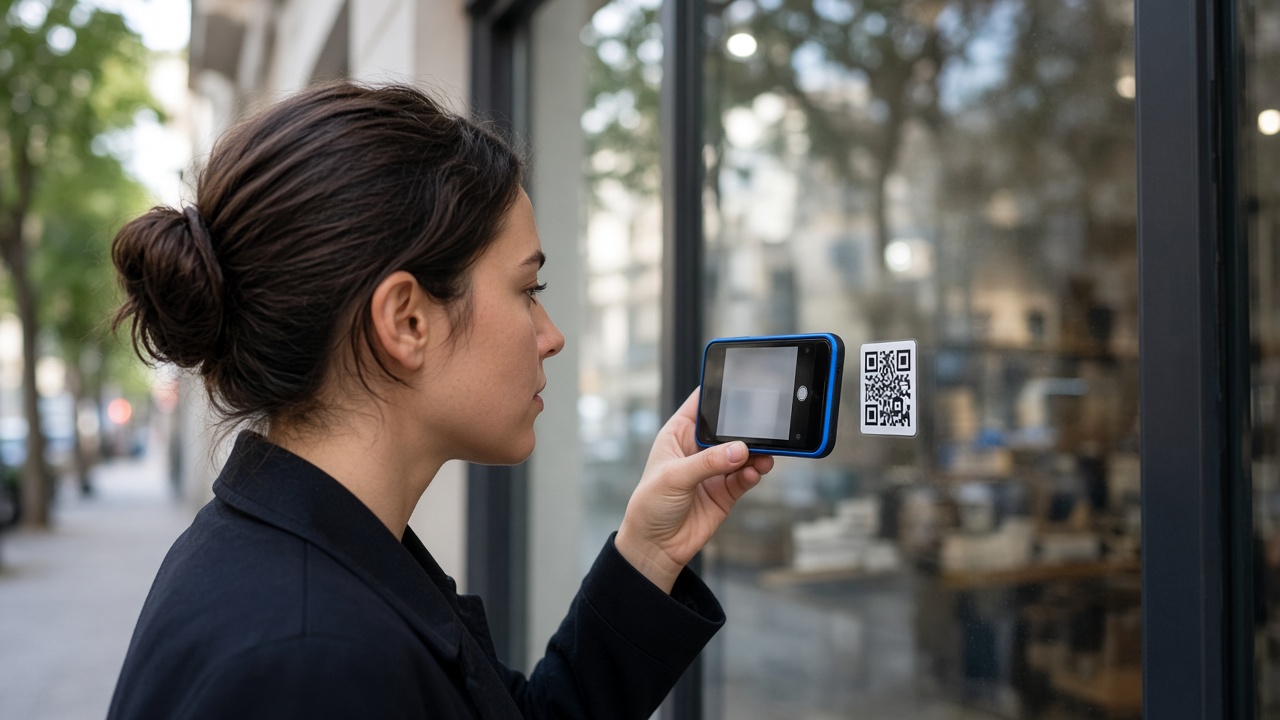
A QR code is not an application and it is not a marketing channel. It is a visual container: a matrix of light and dark modules that a phone reads with the camera and turns into data. That data is usually a URL, though it can also be text, a vCard or network credentials. The value is not in the printed square; it is in the destination it opens and the friction it removes.
What is actually behind the pattern
The code organizes information in a grid. The three position marks in the corners let the reader find the origin, calculate orientation and correct perspective. Alignment and timing marks help when the code is printed on a curved surface, a vehicle wrap or a poorly lit booth. The useful content — the payload — occupies the rest of the matrix.
Error correction is what makes QR usable outside a lab. If a corner is scratched, a mark covers part of the center or there is glare, the reader can still reconstruct the message. That is why a well designed code can tolerate a small brand mark in the center, and why a poorly printed, undersized or low-contrast code fails even when the URL is correct.
How a phone turns it into an action
The flow is short. The camera captures the image. A decoder locates the pattern, straightens it, reads the modules and applies error correction. The result is a string: almost always a web address. The operating system or the browser opens that address. Most current phones do not need a dedicated app: the reader lives in the camera.
That simplicity explains adoption. eMarketer estimates that about 102.6 million U.S. consumers use a smartphone QR scanner. They are not installing a new program; they are using a gesture the hardware already handles. The cost of teaching the gesture is low. The cost of an unreadable code — poor contrast, insufficient size, a broken destination — is high, because a person will not retry three times in front of a poster.
Why QR still matters in 2026
In 2026 the QR code is not a leftover fad. In digital-card exchange it still accounts for about 28% of shares, with 25% year-over-year growth. It remains the cheapest bridge between a physical object — a card, a booth, packaging, a lock screen — and a page you can update, measure and tailor.
The code does not “understand” the customer. It only carries. The quality of the experience is decided by the destination: a clear contact card, a campaign landing page or a file. If the destination asks for too many fields, loads slowly or is not built for mobile, the QR has done its job and the business has lost attention in the next second.
What a business should control
Treating the QR as graphic decoration is the most common mistake. It is an interface. It needs the same decisions as any other entry point:
- A single, honest destination. The user should know what will open. An opaque URL with no context lowers the scan rate.
- Physical readability. Size, quiet zone, contrast and material matter more than the style of the frame.
- Tests on several phones. A code that works on one model and fails on another is usually a print or contrast problem, not “the technology.”
- Someone accountable for the destination. A person must be able to change the URL or the content if the campaign ends or the product is withdrawn.
A QR code works when it stops being a decorative box and is treated as a contract: the object promises a destination, the destination delivers in a few seconds, and the business can see how often that promise was kept. The frame, the mark and the brand color are secondary if the pattern cannot be read or the page does not load.