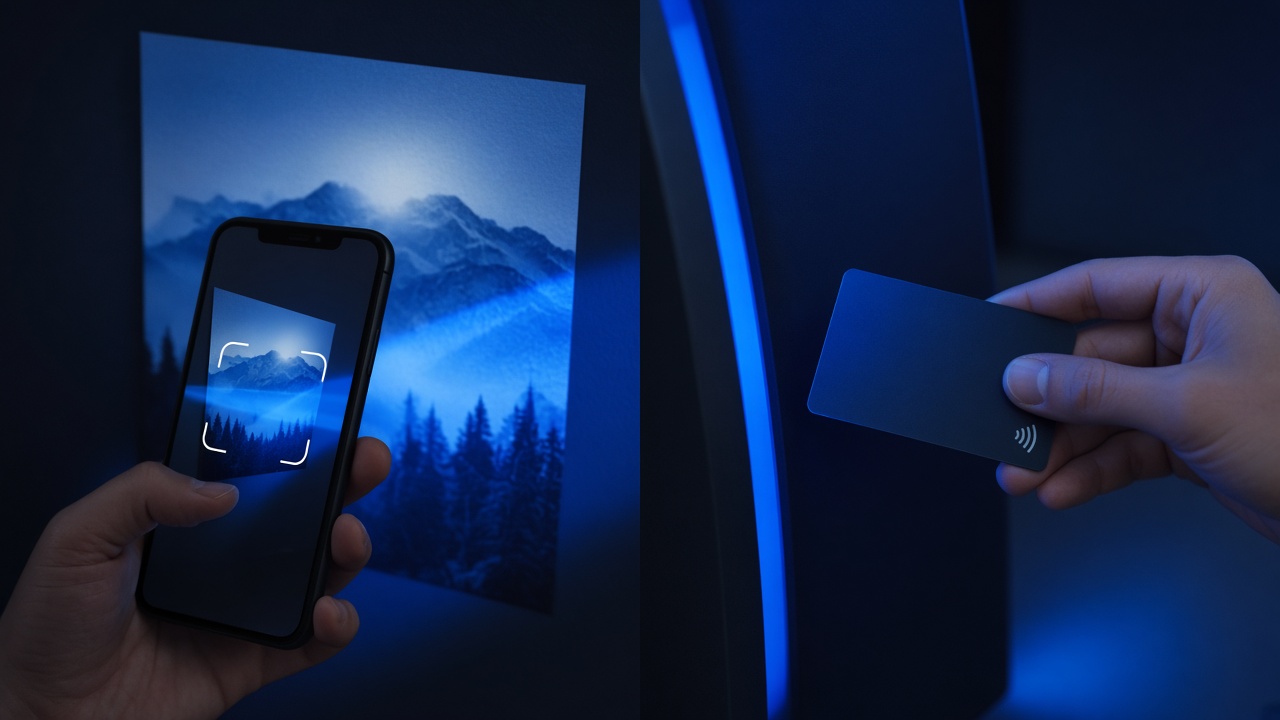
QR and NFC do not compete for the same meter. One is an optical interface: the other person must see the pattern and have enough light for the camera. The other is a radio interface: the chip must come close to the phone. Picking “a winner” is a category error. The work is to decide at which moment in the relationship each one removes more friction.
The difference that matters is the gesture
With QR, the other person takes out the phone, opens the camera — or the system scanner — and frames the code. The gesture works at one meter or at ten, on a poster, a slide or a lock screen. With NFC, they bring the phone to the object. There is no framing. There is no camera. The gesture only exists at a few centimeters. NFC works without a camera and is useful in dim rooms; QR is not.
That physics explains the 2026 numbers. QR remains about 28% of digital-card shares (+25% year over year). NFC cards are 6.9%, with +124% year over year. QR has more volume because there are more surfaces people look at than surfaces they tap. NFC grows faster because the payment gesture is already trained and the hardware is in the pocket.
Advantages of each channel, without mythology
- QR: distance, mass print, screens, packaging, lock screens. About 102.6 million U.S. consumers already use a smartphone scanner (eMarketer). The code can sit where a chip cannot.
- NFC: speed face to face, dark rooms, occupied hands, less “open the camera and aim.” The NFC business-card market is estimated at a 14.8% CAGR through 2034.
- Dynamic QR: the destination can be edited after print. NFC can also point to a URL you control; the chip does not force you to freeze this month’s campaign forever.
- Proximity identity: the 2026 EUDI Wallet uses NFC, BLE and QR (ISO 18013-5). Users already accept both gestures for something more serious than a commercial link.
Use cases, not brand preferences
A trade-show booth needs both. The back panel and the roll-up are scanned at a distance: QR. The card or badge offered in the conversation is tapped: NFC. Packaging on a shelf is QR: nobody will press a phone onto every unit. A table meeting, with low light and open laptops, is NFC. A talk in front of a hundred people is a QR on the slide, not a chip on the lectern.
The usual mistake is forcing a single channel for aesthetics. A team that “only does NFC” leaves out anyone whose radio is off or who does not understand the tap. A team that “only does QR” loses the fastest exchange when two people are already together. The question is not which looks better in a mockup; it is which the other person can complete in that second.
Operations: destination, measurement and fallback
Both channels fail the same way: a slow destination, an incomplete card, nobody follows up. The channel only delivers attention. What happens next — saving the contact, writing the same day, recording the source — is process work, not radio or camera work.
Build a fallback. If NFC does not respond, the same object should show a QR. If the QR cannot be read because of light or size, a short link said aloud or sent in a message saves the contact. That is not indecision: it is design for failure. In 2026, with QR still dominant and NFC accelerating, a mature design offers both gestures on the same destination.
BlimxCard shares the same card via a QR scan or an NFC tap: one destination, two gestures, without inventing a separate channel for every meeting.