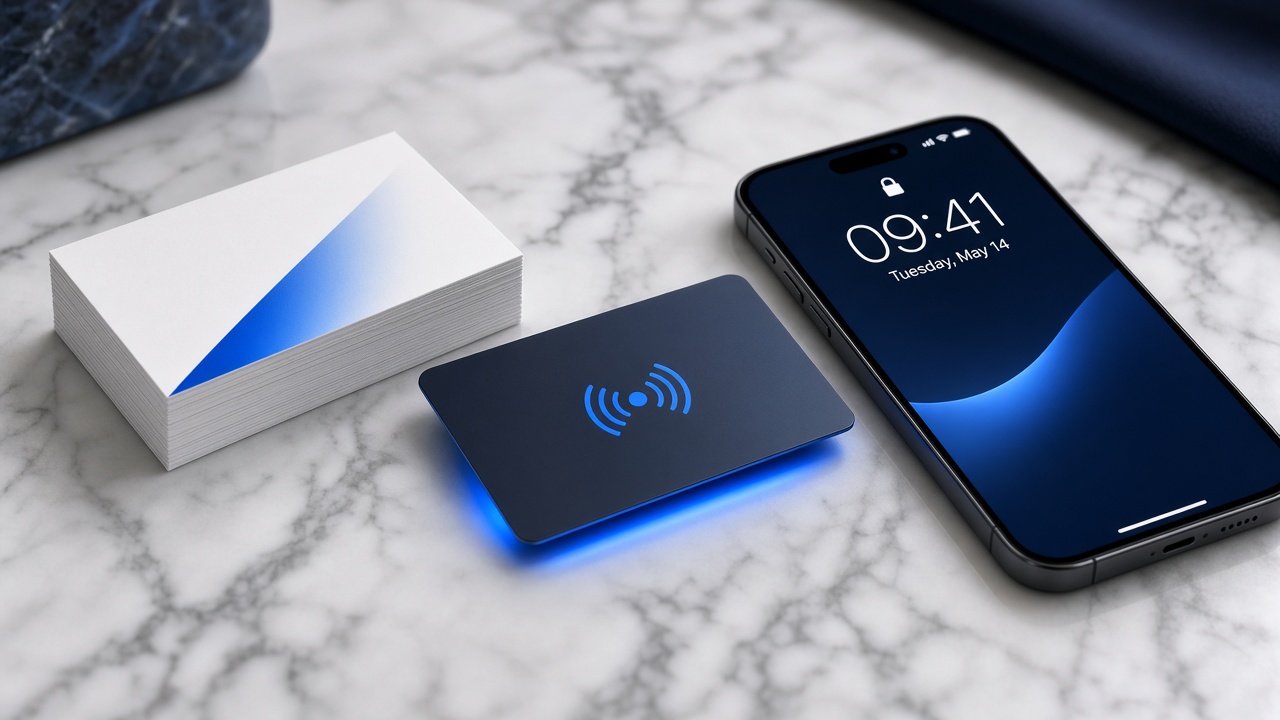
Paper solved a 1980 problem
The printed card was an effective invention: name, title, phone and, later, an email. It fit in a wallet. It was handed over at the end of the meeting. The problem it solved was data scarcity. The problem it created, over time, was expiry: the title changes, the company rebrands, the number is lost and the cardstock stays in a drawer with false information.
Nobody misses the object. What is missed is the ritual: a closing gesture that said here is how to find me. The digital era does not remove that ritual. It moves it to the phone and requires the data still to be true the following week.
A digital card is not a PDF
The first digital attempt was a photo of the cardstock or a file that gets forwarded. That is not an evolution: it is paper with more steps. A serious digital card is a profile with a permanent address. You edit the title and the recipient, the next time they open the link, sees the current version. There is no reprint. There are not half a dozen versions in circulation.
That difference —object versus profile— is the one that matters. The design can be sober or loud. If the content cannot be updated, the digital card ages the same way the printed one does, only faster because it is forwarded more.
How sharing works in 2026
The sharing mix is no longer a trade-show opinion. In 2026, Apple Wallet leads digital card sharing. QR remains at about 28% of exchanges. Lock-screen QR grew around 749% year over year and now covers about 13%. NFC cards account for 7% of shares, with a 124% rise versus the previous year. The NFC card market is projected at a CAGR near 14.8% toward 2034.
Reading those numbers well avoids two errors. The first: declaring QR dead because Wallet is growing. The second: declaring NFC inevitable because it is growing from a small base. The recipient chooses the channel. The sender who prepared only one loses half the meetings.
The value is after the tap
Moving from paper to digital is useless if the gesture ends in a scan. Commercial value appears after: enrich the contact, enter the CRM and write in the first 24 to 72 hours. Paper failed here quietly —the card got coffee-stained and nobody called—. Digital fails loudly: there are sharing metrics and, still, an empty inbox.
- Capture the contact on the spot, not back at the hotel.
- Complete company and context the same day.
- Resume with a sentence from the meeting, not with an empty template.
That sequence is the real evolution. The medium —cardstock, QR, NFC, wallet— is the means.
What was lost and what was gained
The collectible object was lost and, with it, an excuse for not having a system. Immediate correction was gained, exchange in a noisy hallway, and the chance that the same profile lives in an email signature, on a screen and in a tap. A responsibility was gained too: if the profile is wrong, it is visible at once.
Etiquette did not change. Permission to share is still asked. The phone is still not pushed into the face of someone who did not ask for the contact. Technology does not authorize haste. It only removes the apology of not having cards.
A profile that can be corrected the next day
The digital era of the business card comes down to one sentence: the gesture remains human; the data should no longer be static. One example of that model is BlimxCard: a card that opens in the browser, is shared in seconds and is edited without reprinting. It does not replace the meeting. It keeps the encounter from remaining on outdated cardstock.
Anyone still printing out of inertia can keep doing so. The 2026 test is different: if the other person cannot save a current profile before leaving the room, the evolution has not reached that company.