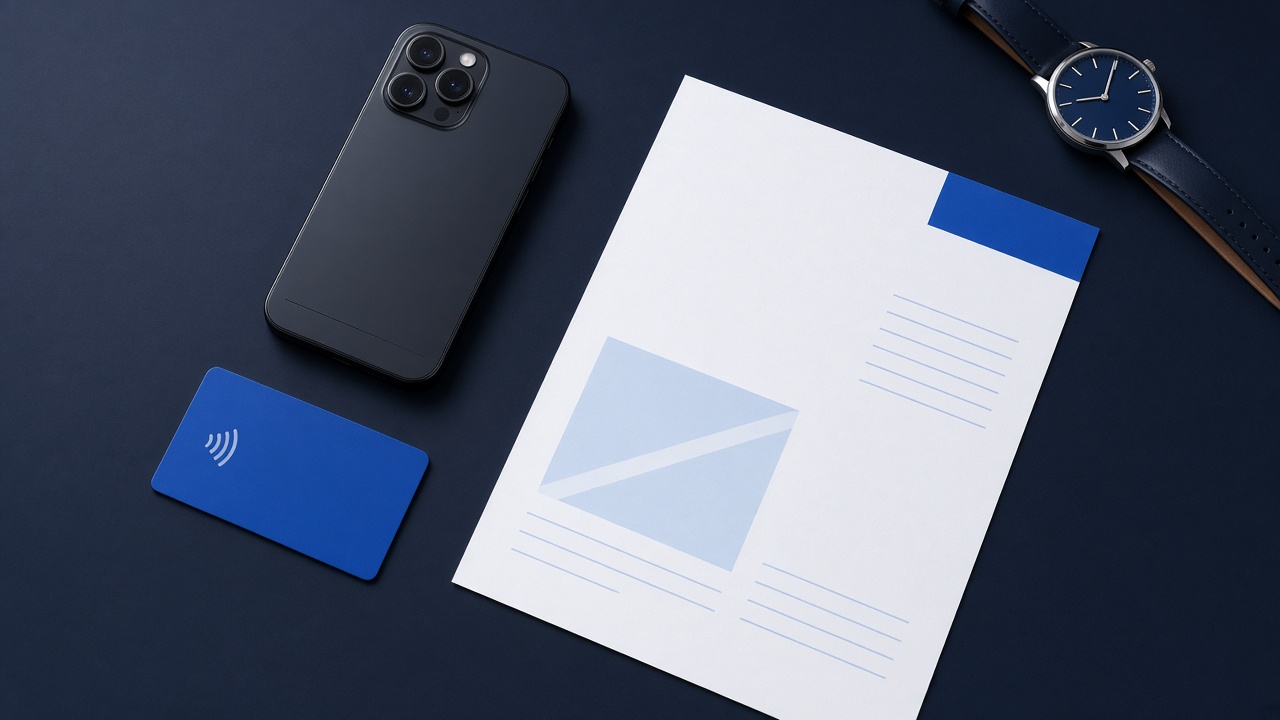
A modern professional identity is not an aesthetic or a “personal branding kit”. It is the minimum set of signals a stranger can use to place you, trust you enough and continue. Those signals fit on a table: name, face, title, company, one proof, a reply channel and a way to carry it. If one is missing, the others work overtime. If they contradict each other, none is enough.
Name, face, title and company
These are the master data. The name is the one you use when you walk into a room, not a variant per network. The face is recognisable at a metre. The title is current, in language a peer would use. The company anchors context; if you work independently, craft occupies that anchor with the same clarity. Without those four, there is no identity. There is a nickname with a photo.
- One spelling, the same on profile, signature and card.
- One active photo, not a different crop on every surface.
- A title you can say out loud without a footnote.
Update them the day they change. Lag is the modern form of the expired card at the bottom of the briefcase.
Card, profile and signature
These are the three delivery surfaces. The profile (almost always LinkedIn: 89% of B2B already works there) is where you are inspected. The signature is where you are found again in the thread. The card is the last metre: name, title and next step when there is no time for a long form. All three must return the same master. If the profile says one thing and the signature another, the modern identity behaves like an old one: it confuses.
You do not need to invent a fourth surface every quarter. You need these three to exist and not to lie. An empty profile with a baroque signature does not balance. Unify. Strip the decorative until a stranger can cite you without opening a second link.
Wallet and portable identity
A modern identity travels. A link, a pass on the phone or a credential avoids the PDF nobody opens and the paper left in the taxi. Gartner places digital identity wallets at about 500 million users; the EU wallet rollout continues in 2026. You do not have to adopt every scheme. You do have to let the other person save you without a tutorial and without retyping what they just saw.
Portable is not “more formats”. It is the same datum in the format the other person already uses. If wallet, card and profile diverge, you have multiplied copies. A modern identity is one master and several vehicles, not several masters.
Proof of work
Without proof, identity is a sign. One piece is enough — a case, a text, a decision — that a peer would forward. On LinkedIn it performs better on the personal profile (3.85% engagement) than on the company page (2.10%). A modern identity rests on the human who can explain the work, not only on the logo.
Proof is updated. A 2019 case and a 2026 title is another lag. Replace, do not accumulate. The stranger rewards the match between what you say you do and what can be seen.
How the pieces fit
The order is hygienic. Master data first. Then the three surfaces. Then the portable vehicle. Last, the proof. Reversing it manufactures distrust. An hour a month to align is usually enough. The rest of the time is spent on the craft, which is the only thing identity cannot fake for long.
Agentic AI can draft a follow-up; Gartner, in 2026, requires company rules before you let it run. An agent is not an element of your identity. It is a process that uses your identity. If it invents the title or the tone, trust before the meeting breaks.
A modern identity fits on a few aligned surfaces. A digital card (BlimxCard is one of them) sits next to the profile, the signature and, when it helps, the wallet pass. What matters is that the name, the title and the next step match. Free starts at
; Pro at .99. The card is a vehicle. Identity is the master.