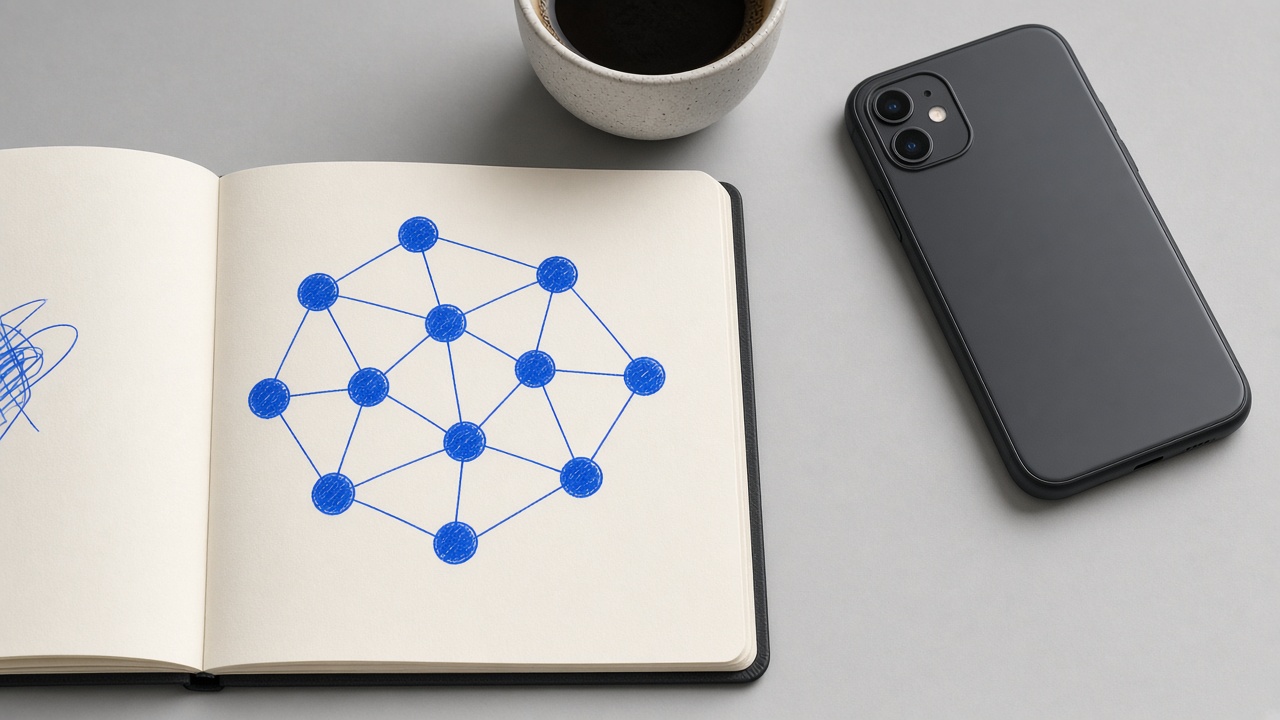
Building a network is not an event
A professional contact network looks more like a maintenance system than a campaign. Events supply density. The rest of the year supplies depth. Anyone who only does networking when there is a trade-show badge builds spikes, not a network.
The strategies below do not ask for charisma. They ask for an order that can be repeated. If it cannot be repeated the following Thursday, it is not a strategy: it is a mood.
Before the meeting
Advance work avoids improvising your own identity. An outdated profile, an old title or a channel nobody can open turns the meeting into an apology. Preparing is not rehearsing a speech. It is arriving with a current profile and with a hypothesis of whom you want to meet and why.
It is also deciding what you are not looking for. A network without criteria fills up with pleasant people and no decision-maker. Scarcity of time forces you to choose the type of contact before entering the room, not afterwards, when fatigue makes everyone equal.
During the meeting
In the room the goal is not to shine. It is to leave with a reason to speak again and with a detail that will not be lost in the hallway. Listen more than you present. Ask permission to share the profile. Write down a sentence that only that conversation explains.
Digital exchange —wallet, QR or NFC— reduces friction. It does not replace the useful question. Anyone who only pushes the phone collects scans. Anyone who asks what problem that person is trying to solve leaves with material for Thursday.
Ten strategies that can be operated
- 1. Keep a current professional profile that is easy to open. If the title changed, edit it the same day.
- 2. Define a network criterion: who decides, who recommends, who informs. Archive the rest without guilt.
- 3. Arrive with a hypothesis, not with a pile of mental cards. Two or three target people are enough.
- 4. Listen in order to extract a reason to return, not in order to wait for your turn to talk.
- 5. Share the contact in the channel the other person can receive, not the one you prefer.
- 6. Capture the detail on the spot and do not trust taxi memory.
- 7. Enrich the same day: company, title, context, who else was there.
- 8. Record it in the company CRM, not only on a personal phone.
- 9. Write in the first 24 to 72 hours with a sentence from the meeting and a possible next action.
- 10. Review the network every month: who is owed an introduction, who is owed a respectful silence, who is owed a clean file.
All ten fit on a checklist. The usual error is to practice the first five —the more visible ones— and abandon the last five, which are the ones that turn the meeting into an asset.
Afterwards: the work almost nobody does
The later stretch is where the network is truly built. Enrichment, CRM and follow-up are not “administration”. They are the act of respecting the other person’s time: not making them repeat who they are, not disappearing, not coming back six months later with a message that could be sent to anyone.
If the team uses AI to draft the follow-up, the text must be signable by the human who was at the table. An agent without company controls speeds up sending and destroys the judgment in strategies 2 and 9. The network does not grow by message volume. It grows by messages that only that meeting justifies.
How to know whether the network is alive
A living network is measured with three questions, not with a profile count. First: how many contacts from the last 90 days have a written reason to return? Second: how many are in the CRM and not only on a phone? Third: how many received a punctual message within 72 hours? If those figures are low, an event is not missing. The later habit is.
Building a professional network is a slow craft. The ten strategies prevent the self-deception of confusing social density with relational capital. The capital is counted when someone replies.